

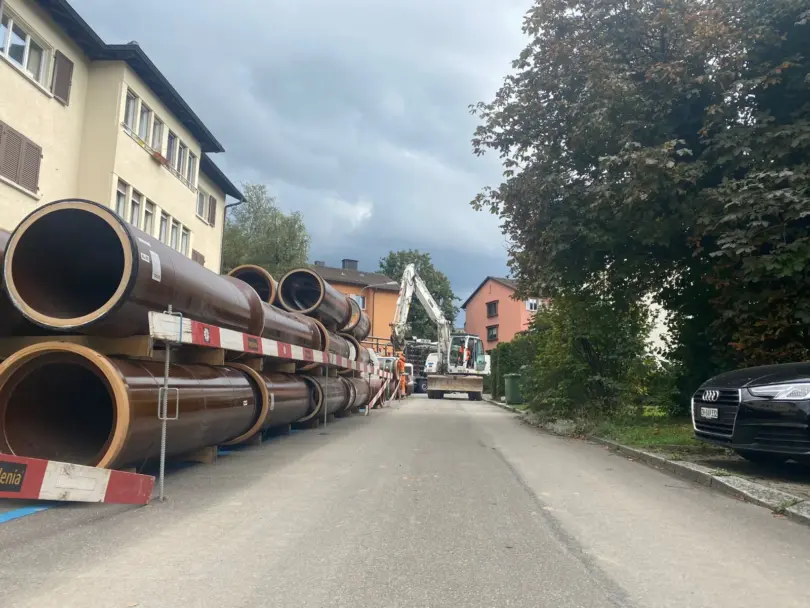
The City of Zurich has completed a Zurich sewer reconstruction project in the Oerlikon district, replacing approximately 800 m of sewer pipeline at depths of 3 to 7 metres within a 52-week timeframe. The €6 million programme used KERA.Pro vitrified clay pipes supplied by Steinzeug-Keramo, a pipe manufacturer that is part of the wienerberger group.
The project was designed by consultants Heierli AG and delivered by contractors Implenia Schweiz AG. According to Steinzeug-Keramo, the works were completed without disrupting key transport routes.
Upgrading capacity in a growing district
Oerlikon is a congested district of Zurich with a mix of residential, industrial and recreational development that has outgrown its existing sewer network. As the district continues to develop, its wastewater network requires investment to meet changing demands.
The City of Zurich commissioned the upgrade with a strict one-year delivery timeframe. A central aim was to increase hydraulic capacity to accommodate population growth and new developments, while providing reliable performance for decades to come.
Deep open-cut installation in a confined space
Surrounding infrastructure and traffic routes had to remain operational throughout construction. This added to the complexity of excavation, particularly where disruption to transport routes and nearby businesses had to be minimised, and called for careful planning to enable deep open-cut installation within the limited space available.
The most demanding element was an 86 m section built within a corridor just 1.25 m wide. The deep, narrow trench was stabilised using in-situ reinforced concrete, which required close coordination of construction activities in the restricted working space.
At depths of 3 to 7 metres, the pipes had to withstand significant structural loads from the surrounding ground and surface conditions. Because future intervention at such depths would be complex and costly, the project required a durable, low-maintenance solution.
Vitrified clay pipes for the Zurich sewer reconstruction
KERA.Pro pipes in nominal diameters ranging from DN 300 to DN 800 were installed. The extra-strength pipes are manufactured in accordance with the European standard EN 295, and Steinzeug-Keramo said they combine high mechanical strength and dimensional stability with resistance to chemical attack, making them suited to deep excavations and areas subject to heavy traffic loads.
The company also pointed to the chemical and corrosion resistance of vitrified clay, including resistance to hydrogen sulphide (H₂S), which helps maintain material integrity in aggressive wastewater environments. Combined with a smooth, glazed interior surface that supports hydraulic performance, Steinzeug-Keramo said these characteristics contribute to a service life of more than 150 years.
According to the company, durability and low maintenance were key considerations in the pipe selection, with the aim of minimising future repair and replacement requirements and delivering long-term asset reliability and whole-life value.
Long-term capacity for Oerlikon
Alongside the new pipe system, the reconstruction increased hydraulic capacity to accommodate future urban development in the district. Surface impact was minimised throughout construction, the company said.
The Civil Engineering Department of the City of Zurich said: “With Oerlikon continuing to grow rapidly, investing in a durable and future-proof sewer system was essential. This project ensures capacity and reliability for decades to come.”
The project illustrates how construction constraints and long-term asset performance are both weighed when specifying sewer pipe systems for urban infrastructure. H2O Global News has previously reported on extending the lifespan of sewer systems with vitrified clay pipes.
Frequently asked questions
What was the Zurich sewer reconstruction project in Oerlikon?
It was a €6 million programme commissioned by the City of Zurich to reconstruct approximately 800 m of sewer pipeline in the Oerlikon district. It was designed to increase hydraulic capacity for population growth and new developments.
Who designed and built the Oerlikon sewer project?
The project was designed by consultants Heierli AG and delivered by contractors Implenia Schweiz AG. KERA.Pro vitrified clay pipes from Steinzeug-Keramo were used.
How deep were the sewer pipes installed in Oerlikon?
The pipes were installed at depths of 3 to 7 metres. One 86 m section was built within a corridor just 1.25 m wide, with the trench stabilised using in-situ reinforced concrete.
What size pipes were used in the Zurich sewer project?
KERA.Pro vitrified clay pipes in nominal diameters ranging from DN 300 to DN 800 were installed. They are manufactured in accordance with EN 295.
How long did the Oerlikon sewer reconstruction take?
The sewer line was completed within the 52-week timeframe set for the project. According to Steinzeug-Keramo, this was achieved without disrupting key transport routes.