


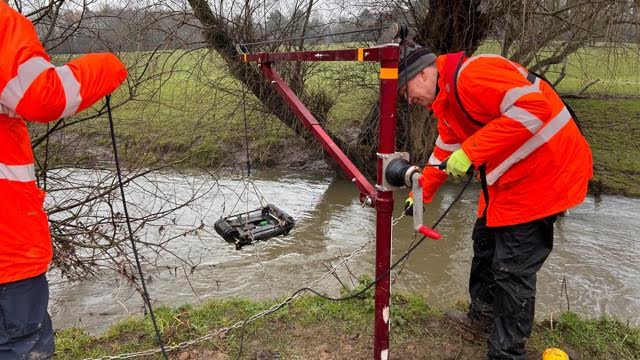
Collaboration between technology providers, water companies and delivery partners is playing a growing role in enabling rapid, low-impact deployment of continuous water quality monitoring across UK rivers.
At a recent site in Ilkeston, the CSignum team demonstrated how its wireless river monitoring system can support Severn Trent Water’s Section 82 Continuous Water Quality Monitoring (CWQM) programme. The deployment was carried out alongside estates and ecology teams, working with delivery partners BGEN and CEMA.
Addressing deployment challenges in complex river environments
The focus of the on-site demonstration was not the monitoring technology itself, but how to overcome practical deployment challenges and complete installations safely within a short timeframe. The system was deployed within a few hours across a range of difficult conditions, including steep and constrained riverbanks and bridge-mounted locations.
A portable mini-davit system was used to support safe installation, aligned with Severn Trent Water’s operational and hazard requirements. This approach allowed equipment to be positioned efficiently while minimising disruption to the river environment.
Wireless monitoring reduces cost and environmental impact
Feedback from the combined project team highlighted several advantages of a wireless monitoring approach. Predictable site costs help avoid expensive civil works and unknown engineering risks, while rapid deployment reduces environmental impact and enables systems to become operational within hours.
The configuration is suitable for flood-risk locations, with gateways positioned safely above river level. It also supports deployment in urban environments or high-footfall public areas, as topside gateways can be located discreetly up to 100 metres away and out of sight.
The portable nature of the system allows monitoring points to be relocated as requirements change. This flexibility is particularly relevant for bathing waters, SSSI and UNESCO-designated sites, and for rivers with steep, concrete or fast-flowing channels. Where proximity allows, clustered combined sewer overflow (CSO) monitoring points can also be supported using a single gateway.
Supporting Section 82 continuous monitoring requirements
CSignum’s wireless monitoring system has been developed specifically to support the Environment Agency’s Section 82 CWQM programme, using the company’s patented EM-2 Electromagnetic Field Signalling (EMFS) technology.
The Ilkeston deployment included an EM-2Q riverbed assembly integrating an EM-2 modem with a Xylem EXO2s sonde, alongside an EM-2G topside gateway incorporating an EM-2 modem and telemetry unit.
The gateway can be positioned up to 100 metres from each riverbed system, enabling flexible upstream and downstream CSO monitoring while maintaining a low visual and environmental footprint.
CSignum thanked Severn Trent Water, BGEN, CEMA and Ovarro for their collaboration and on-site engagement, noting that close cooperation across disciplines is essential to tackling complex catchment challenges.
Related: Water quality monitoring


