


Quick answer: Cloud seeding is a weather-modification technique that makes certain clouds produce more rain or snow. Tiny particles — most commonly silver iodide — are released into moisture-rich clouds, giving water droplets something to form around so they grow heavy enough to fall. In the right conditions it can raise precipitation by roughly 10–15%, and it is used mainly to ease drought and support water supplies.
In many parts of the world, water is becoming harder to find. Droughts are lasting longer, rainfall is less predictable, and some communities are struggling to get enough water for crops, homes, and businesses. As the climate continues to change, the need for innovative water solutions is greater than ever. One method gaining attention is cloud seeding, a type of weather modification that helps certain clouds produce more rain or snow. While the idea of “making it rain” may sound like science fiction, cloud seeding has been used for decades in countries around the world, including the United States. But what is cloud seeding and how does it work? What are the risks? And can it really help solve water problems? In this article, we’ll explain what cloud seeding is, how it works, the cloud seeding process, its types and uses, and why it’s both promising and controversial.What Is Cloud Seeding?
Cloud seeding is a weather modification technique that encourages clouds to produce more precipitation, resulting in increased rainfall, snowfall, or even hail. It doesn’t create clouds from scratch but instead enhances the moisture already in the sky. The process involves adding special materials, called seeding agents, into the air to help water droplets form more easily. These agents act like a “starter” for rain. Once the water droplets grow big and heavy enough, they fall from the sky as precipitation. The history of cloud seeding dates back to the 1940s and continues to be explored as a means to help manage droughts, enhance snowfall, and mitigate severe weather.How Does Cloud Seeding Work?
Clouds are made of tiny droplets of water or ice. But not all clouds are ready to rain. For raindrops or snowflakes to form, water needs something to stick to a solid particle that acts like a core. That’s where cloud seeding comes in. Here’s a step-by-step look at how it works:- Choosing the Right Cloud: First, meteorologists look for clouds that have enough moisture but haven’t started raining yet.
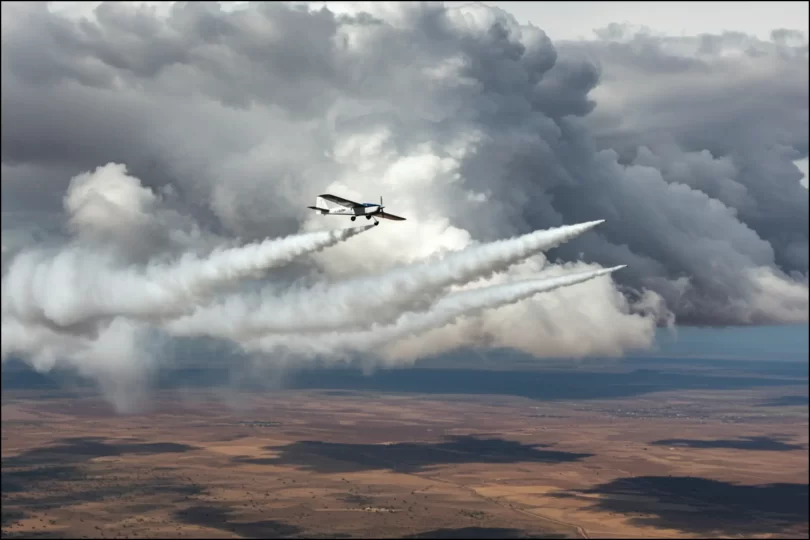
- Seeding the Cloud: Planes, cloud seeding aircraft, rockets, drones, or ground-based generators release seeding agents into the cloud. Common substances include:
- Silver iodide is most widely used; it helps ice crystals form in cold clouds.
- Salt particles are used in warm clouds to absorb moisture.
- Dry ice (frozen CO₂) cools the cloud to encourage ice formation.
- Raindrop Formation: The added particles act like dust that water can cling to. As more moisture collects, the droplets grow larger.
- Precipitation: When the droplets get too heavy, they fall as rain, snow, or hail depending on the temperature.
 Cloud seeding usually works best in existing clouds that already have some moisture. It cannot create rain out of clear blue skies.
Types of Cloud Seeding
There are three main types of cloud seeding, each used for different weather conditions:1. Static Seeding
This is the most common method. It adds silver iodide to cold clouds to encourage the formation of ice crystals, which then grow and fall as snow or rain.2. Dynamic Seeding
This technique aims to make clouds grow larger and stronger by altering airflow inside the cloud. It requires more material and complex planning, but can increase the potential for heavy rain.3. Hygroscopic Seeding
Used mostly in warm climates, this method spreads salt particles that absorb water and grow into raindrops. It’s often used in desert regions.Why and Where Is Cloud Seeding Used?
Cloud seeding has been used around the world to solve different weather-related problems. Here are some benefits of cloud seeding:- Boosting Rainfall in Drought Areas In dry regions, cloud seeding is used to increase rainfall and help farmers, water reservoirs, and rural communities.
- Increasing Snowpack for Water Supply In mountain areas, more snowfall means more water in rivers and lakes when the snow melts in spring.
- Reducing Hail Damage Some programs use seeding to reduce the size of hailstones during thunderstorms, protecting crops and buildings.
- Clearing Fog Around Airports Seeding can help thin out fog, making it easier and safer for airplanes to land and take off.
Where It’s Used in the U.S.
Cloud seeding is used in several western U.S. states, including:- California cloud seeding programs help increase snow in the Sierra Nevada.
- Colorado enhances snowpack to maintain water supplies.
- Utah and Nevada run winter snowfall programs and drought relief initiatives.
- Texas and North Dakota use cloud seeding for rain enhancement and hail suppression.
Does Cloud Seeding Really Work?
The effectiveness of cloud seeding varies depending on several factors. Studies have shown benefits of cloud seeding ranging from a 5% to 20% increase in precipitation.
- The amount of moisture in the cloud
- Wind and temperature conditions
- The timing and type of seeding
- The size of the area being seeded
Is Cloud Seeding Safe?
Most experts agree that cloud seeding is safe. Here’s what chemicals are used in cloud seeding:- Silver iodide (used in very small amounts)
- Salt
- Dry ice (frozen CO₂)
Controversies and Concerns
Despite its benefits, cloud seeding has raised some concerns: 1. Environmental Concerns Although the chemicals used are considered safe, some fear the long-term impact on soil and water, especially near farmlands or drinking water sources. Read more about the negative effects of cloud seeding to understand the growing environmental scrutiny. 2. Ethical Questions Who gets to control the weather? If one area gets rain, could it take moisture away from another region? 3. Weather Wars & Conspiracy Theories Some people believe cloud seeding is used for secret or harmful purposes. However, these claims are not supported by science. 4. Legal and Liability Issues If cloud seeding causes unexpected floods or weather changes, could someone be held responsible? This is still a grey area in weather law.The Future of Cloud Seeding
As the global demand for water grows, interest in cloud seeding continues to rise. Some scientists are exploring new materials that are more environmentally friendly. Others are using AI and weather data models to better predict when and where seeding will be most effective. Governments and private companies are investing in new seeding programs, especially in drought-prone areas, as a way to protect water supplies and support agriculture. Still, most experts agree: cloud seeding is a tool, not a solution. It may help in some situations, but it cannot replace long-term water planning, conservation, and climate adaptation. Alongside large-scale infrastructure solutions such as creating artificial lakes to store and manage water, cloud seeding offers another tool in the broader strategy to combat water scarcity.Key takeaways
- Cloud seeding encourages suitable clouds to produce more rain or snow.
- The main seeding agent is silver iodide, which acts as a nucleus for water droplets or ice crystals.
- It only works when moisture-laden clouds are already present, and can raise precipitation by roughly 10–15% in favourable conditions.
- Current research suggests it is broadly low-risk, though large-scale effects are not fully understood.
- It is used mainly to address drought and water scarcity, with ongoing debate about effectiveness and side effects.
Conclusion
Cloud seeding is a powerful example of how science can work with nature to solve modern problems. It doesn’t create storms or bring instant rain, but it can help make better use of the clouds we already have. As climate change and water shortages continue to grow, tools like cloud seeding may play a bigger role in how we manage our planet’s most precious resource: water. Still, it’s important to remember that cloud seeding is not a magic fix. It’s one of many strategies, along with conservation, recycling, and improved infrastructure, that can help secure a safe and sustainable future for people and the environment.Frequently asked questions
Cloud seeding is a weather-modification technique that encourages clouds to produce more rain or snow. Tiny particles — usually silver iodide — are released into suitable clouds to give water droplets something to form around.
Aircraft or ground generators release seeding particles such as silver iodide into clouds that already contain moisture. The particles act as nuclei that help water droplets or ice crystals form, grow heavy and fall as precipitation.
It can, but only when the right kind of moisture-laden clouds are present. Reviews by the U.S. Government Accountability Office estimate it can increase precipitation by roughly 0–20%, often cited around 10–15% in favourable conditions, though effects are hard to measure precisely.
Existing research suggests the small amounts of silver iodide used do not pose a significant health or environmental risk at current levels. However, the effects of much more widespread use are not fully known, and some studies flag possible bioaccumulation in aquatic environments.
The most common agent is silver iodide. Potassium iodide and dry ice (frozen carbon dioxide) are also used, and hygroscopic salts such as table salt are used in warm-cloud seeding.
Mainly to boost rain or snowfall in drought-prone or water-scarce regions, to support agriculture and water supplies, and in some places to suppress hail or clear fog.
Sources
- U.S. Government Accountability Office, Cloud Seeding Technology: Assessing Effectiveness and Other Challenges.
- Desert Research Institute, What is Cloud Seeding?