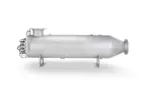



Energy Recovery will supply its PX Q650 pressure exchanger to a major Saudi desalination plant, with the company saying the new seawater reverse osmosis facility will rank among the world’s ten largest when completed.
The contract covers Energy Recovery’s newest and highest-capacity PX Pressure Exchanger technology, designed to recover energy within the seawater reverse osmosis (SWRO) process.
Energy Recovery has not disclosed the name, capacity or contract value of the Saudi Arabian project.
Saudi desalination plant to use PX Q650 technology
Energy Recovery launched the PX Q650 in March 2026 for large-scale seawater desalination facilities.
The company says the device has a peak flow capacity of 650 gallons per minute, equivalent to approximately 147.6m³/h, representing a 63% capacity increase over its previous PX Q400 model.
Energy Recovery reports peak efficiency of up to 99% and says the higher flow capacity can allow fewer pressure exchangers to be used within individual reverse osmosis trains.
The latest Saudi desalination plant order follows other PX Q650 contracts secured for projects in Asia and the Middle East earlier this year.
Rodney Clemente, Senior Vice President of Water at Energy Recovery, said: “We engineered the PX Q650 for the performance, scale, and operating demands of the world’s leading desalination plants, so seeing it specified only months after launch confirms what we set out to build.
“An operator running a plant of that size thinks in decades, not years, and capacity, specific energy consumption, and uptime are what shape those operating costs. We’re proud to support the Kingdom’s water security goals with our highest-capacity technology yet.”
Energy recovery reduces power demand in reverse osmosis
Seawater reverse osmosis requires seawater to be pressurised before it passes through membranes that separate salts and other dissolved substances from the water.
Energy Recovery’s PX devices transfer pressure from the high-pressure reject stream back into the desalination process, reducing the amount of additional pumping energy required.
The company says its PX technology can reduce the energy required for seawater reverse osmosis by up to 60%. Energy Recovery also reports that its technology supports the production of approximately 48.5 million cubic metres of water per day globally.
Further technical information on the company’s PX Pressure Exchanger technology is available from Energy Recovery.
Desalination remains central to Saudi water supply
Desalination plays a major role in Saudi Arabia’s drinking-water supply because of the country’s limited natural freshwater resources.
Official Saudi government material states that seawater desalination provides around 70% of the Kingdom’s potable water and identifies improvements in desalination energy efficiency as part of efforts to reduce the sector’s environmental impact.
Saudi Arabia has increasingly shifted towards reverse osmosis technology as it expands desalination capacity and seeks to reduce the energy requirements associated with freshwater production.
Energy Recovery has also been expanding its presence in the country. Earlier this year, the company finalised a lease for a manufacturing facility near Dammam Second Industrial City, which is expected to become operational in 2027.
H2O Global News previously reported on Energy Recovery’s plans to manufacture desalination technology in Saudi Arabia.
PX Q650 adoption grows following 2026 launch
The PX Q650 uses an isobaric pressure-exchange design with one moving part manufactured from alumina ceramic.
Energy Recovery gives the device a 30-year design life and says its design is intended to reduce maintenance requirements in large-scale desalination applications.
The latest contract adds to a series of Saudi Arabian orders secured by the company as the Kingdom continues investing in new SWRO capacity.
More desalination and treatment developments are available in H2O Global News’ Water Treatment coverage.
Source: Energy Recovery