


In what is regarded as the World Capital of Olive Oil, the retrofit and upgrading of an existing Sequencing Batch Reactor Process (SBR) has increased treatment capacity and the opportunity to reuse the treated water.
At the Coosur treatment facility in Jaén, southern Spain, which generates an average daily effluent flow of 100 m³/day (120 m³/day peak) from olive oil production, a Dissolved Air Flotation (DAF) process (pH-adjusted from 3.5 to 6.5 and dosed with coagulant and flocculant), was installed upstream of the Membrane BioReactor (MBR). The Chemical Oxygen Demand (COD) and Total Suspended Solids (TSS) of the DAF influent is 4,500 mg/L and 700 mg/L on average respectively, with a conductivity of more than 4,000 μS/cm.
By coupling a new filtration skid to the existing biological reactor. Membracon were able to provide an effluent free from suspended solids and bacteria that could then be post-treated by Reverse Osmosis to generate a product-water for reuse in industrial cleaning operations – while surplus effluent is discharged to a nearby surface water. A decanting centrifuge is now used for sludge dewatering, prior to it being tankered off site.
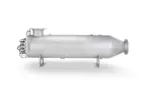
The Coosur plant operates at a Mixed Liquor Suspended Solids (MLSS) concentration of 8,000 mg/L. The sludge is pumped at a feed pressure of 4.5 bar, and the system then operates with a nominal and maximum Transmembrane Pressure (TMP) of 1.8 and 2.5 bar respectively. The activated sludge is recirculated with a Cross-Flow Velocity (CFV) of 3 m/s through a skid fitted with 6 vertically-aligned ceramic modules. The skid provides 54.6 m² membrane area and a footprint of just 3,900 x 2,300 mm (9 m²). The net flux is 83 LMH (Liters per square meter per hour), sustained by chemical cleaning 3-5 times/year with Sodium hydroxide (NaOH) and nitric acid (HNO3) for alkaline and acid cleaning, respectively. The MBR permeate COD (Chemical Oxygen Demand) is below 180 mg/L, representing an overall train removal of more than 96%, with a low Silt Density Index (SDI)
‘Opportunity to reuse the treated water’
Carl Stanford, Operations Director at Membracon, said: “Despite the fact that wastewaters from olives are very problematic because of their high organic matter, high phenolic content, high salinity and conductivity, we have provided a previously untouched opportunity to reuse the treated water, as well as increase the plant’s capacity. This project, together with an increasing number of our installations in the UK, Europe India, China and Taiwan demonstrate what our high-performance water treatment systems and advanced technologies can offer to industry at a time when water is such a very precious resource.”
This latest work by Membracon follows its recent acquisition in the UK of Specialist Plastic Manufacturing (SPM), which has provided it with an additional 8,000 sq ft of fabrication and warehouse space.