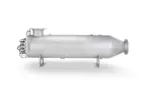



Salinity Solutions and SUEZ have launched a municipal wastewater reuse pilot in Béziers, France, using Hybrid Batch Reverse Osmosis (HBRO) technology designed to improve water recovery and reduce operational costs.
The pilot, operating at the Béziers wastewater treatment plant, is the first deployment of HBRO technology under real municipal conditions, aiming to increase water reuse efficiency while lowering energy consumption and chemical usage.
Developed by Salinity Solutions, the HyBatch™ system is based on a piston-driven pressure exchange process that enables the recycling of brine multiple times to maximise water recovery.
Hybrid Batch Reverse Osmosis pilot improves wastewater reuse efficiency
The technology is designed to achieve water recovery rates of 90–95%, compared to approximately 85% for conventional reverse osmosis systems. By reusing brine within the process, the system reduces scaling, lowers the need for chemical cleaning and extends membrane lifespan.
The pilot is supported by ADEME and combines Salinity Solutions’ HyBatch™ technology with SUEZ’s expertise in wastewater treatment and infrastructure delivery.
Richard Bruges, CEO of Salinity Solutions, said: “By proving that high recovery can be achieved reliably and efficiently at large scale, with increased energy efficiency, we aim to set a new benchmark for advanced wastewater treatment worldwide.”
Gregory Tesse, Infrastructure and Innovation Director for Engineering & Construction at SUEZ, added: “The Hybrid Batch Reverse Osmosis technology provides substantial benefits for wastewater reuse in terms of water, energy and chemical savings.”
Advancing sustainable water reuse technologies
The development of high-efficiency wastewater reuse solutions is becoming increasingly important as water scarcity intensifies globally due to climate pressures and growing demand.
The Béziers pilot demonstrates the potential for HBRO technology to support large-scale water reuse, not only for municipal wastewater but also for surface water and brackish water treatment applications.
By reducing operating costs and improving efficiency, the technology could help expand the adoption of reverse osmosis systems across both municipal and industrial sectors.
For more on water reuse innovation, visit our Water Treatment section.