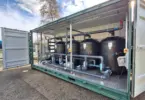



Curio Water has launched a modular treatment platform designed to improve the quality of water discharged during storm-overflow events.
BlueBarrier Stormwater can be configured to treat flows captured from storm overflows, including combined sewer overflows. The platform combines physical filtration, biological treatment and ultraviolet disinfection, with the exact treatment sequence determined by conditions at each site.
Treatment option for wet-weather discharges
Storm overflows act as relief points when rainfall causes flows in combined sewer networks to exceed available capacity. Conventional improvement projects commonly involve additional storage, increased sewer capacity, surface-water separation or measures that reduce the amount of rainfall entering the network.
BlueBarrier is intended to provide another option by treating captured wet-weather flows before their release into receiving waters. It does not prevent the overflow from operating, but aims to reduce the pollutant load associated with the resulting discharge.
Curio is targeting locations where discharges could affect bathing waters, shellfish waters, urban rivers or environmentally sensitive sites. These could include Sites of Special Scientific Interest, Special Areas of Conservation and water bodies failing Water Framework Directive objectives.
Pilot testing before full-scale installation
Every proposed deployment will begin with feasibility testing using Curio’s containerised pilot equipment. Testing will examine factors including suspended-solids loading, phosphorus concentration and variations in flow during storm events.
The resulting data will be used to determine the size and sequence of the full treatment train before capital is committed. This site-specific process is necessary because the composition and hydraulic characteristics of storm flows can vary considerably between sewer catchments and individual rainfall events.
Curio says performance objectives will be established for each location and validated through testing. The company is targeting total suspended-solids reductions of between 80% and 95%, alongside reductions in biochemical oxygen demand, phosphorus and pathogen loading.
These figures are performance targets rather than independently verified results from a named full-scale installation.
Partners provide different treatment stages
Curio has assembled a group of technology partners to provide the individual stages of the platform.
Hydrotech, part of Veolia, will provide cloth filtration to remove fine particulates and particulate-bound phosphorus. Chemical dosing can be added where a project requires enhanced phosphorus removal.
Veolia Water Technologies will supply packaged rotating biological contactor or moving bed biofilm reactor systems. These biological processes are designed to reduce organic loading and, where required, support nitrogen removal.
UV Guard will provide ultraviolet disinfection as the final treatment stage. An advanced oxidation configuration combining UV and hydrogen peroxide can also be considered where additional oxidation is required.
Curio Water will be responsible for engineering integration and project delivery across the complete treatment train.
AMP8 investment targets storm-overflow performance
The launch comes during the 2025–2030 AMP8 investment period for water companies in England and Wales. Ofwat’s price-review programme includes approximately £10 billion for reducing storm-overflow spills and upgrading around 2,500 overflow assets.
The government’s Storm Overflows Discharge Reduction Plan requires water companies to improve all overflows discharging into or near designated bathing waters by 2035. At least 75% of overflows discharging into or near high-priority ecological sites must also be improved by that date.
Government guidance allows disinfection to support bathing-water objectives in appropriate circumstances. Companies must still meet the applicable ecological, public-health and rainfall targets for each overflow.
Storage remains a significant part of current investment programmes. H2O Global News recently reported on new pumping and storm-storage infrastructure around the Taw Torridge Estuary, including a tank capable of holding 750,000 litres during wet weather.
Wet-weather treatment is also being developed internationally. A planned high-rate treatment facility in Toronto will treat up to 600 million litres of combined sewer and stormwater flow per day.
BlueBarrier platform expands beyond micropollutants
BlueBarrier was originally introduced as a containerised platform for treating PFAS and other micropollutants in wastewater. That configuration combines technologies including ozonation, ultrafiltration, activated carbon and UV treatment.
H2O Global News previously covered the launch of the BlueBarrier PFAS and micropollutant treatment platform. The stormwater version uses a different treatment sequence designed around the solids, organic matter, nutrients and pathogens found in wet-weather flows.
“Most of the debate about storm overflows has been about stopping them operating,” said Howard Marles, chief executive and founder of Curio Water. “That matters, but it is slow and expensive work, and the spills continue in the meantime.”
Marles said the company wants to provide a treatment option at sites where improving discharge quality could produce the greatest environmental benefit. Curio is based at Cranfield University’s technology park in the UK.
Frequently asked questions
What is BlueBarrier Stormwater?
BlueBarrier Stormwater is a modular treatment platform designed for flows captured from storm overflows, including combined sewer overflows.
What treatment processes does it use?
The platform can combine cloth filtration, rotating biological contactors or moving bed biofilm reactors, and ultraviolet disinfection. Chemical dosing and UV advanced oxidation can be added where required.
What pollutants is the platform designed to reduce?
Depending on the site configuration, the system is intended to reduce suspended solids, phosphorus, biochemical oxygen demand and pathogen loading.
What performance does Curio expect?
Curio is targeting total suspended-solids removal of between 80% and 95%, with other performance objectives established and validated for each site.
Does BlueBarrier replace storm storage or sewer separation?
No. It provides an additional treatment option for captured overflow flows and can complement storage, sewer separation, sustainable drainage and wider network improvements.