

The Mohamed bin Zayed Water Initiative (MBZWI) has announced the first project to be supported by its Water Catalyst Research Grant: a two-year partnership between the Georgia Institute of Technology (Georgia Tech), the Massachusetts Institute of Technology (MIT) and United Arab Emirates University (UAEU) to develop more energy-efficient atmospheric water harvesting technology. Field testing of the system is planned in the UAE.
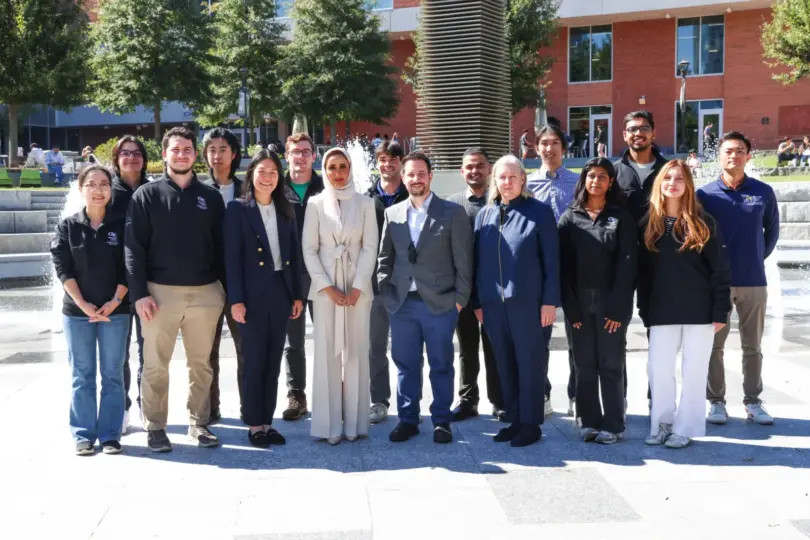
The announcement was made on 17 November 2026 from Abu Dhabi and Atlanta. The grant agreement was signed at Georgia Tech, officially launching the collaboration.
A dual system for atmospheric water harvesting
The project is led by Dr Bachir El Fil, Assistant Professor at Georgia Tech’s George W. Woodruff School of Mechanical Engineering. It draws on expertise from the US and the UAE in atmospheric water harvesting, advanced materials and system design, with the aim of producing water directly from the atmosphere across a wide range of humidity conditions.
The technology will integrate hygroscopic salt-impregnated hydrogels, which capture moisture from the air, with engineered mesh membranes designed to harvest water from fog and high-humidity conditions. By combining the two approaches in a single system, the team aims to enable reliable water production in diverse environments while minimising energy consumption.
Dr El Fil said: “We believe clean water should be available to anyone, anywhere, under any conditions. Achieving that requires rethinking water harvesting from the material up, designing sorbents and devices together rather than in isolation, while keeping cost low enough that the technology is accessible to all.”
Moving water technologies beyond the laboratory
The Water Catalyst Research Grant is a global programme open to researchers, innovators and organisations worldwide. According to MBZWI, it is designed to advance promising water technologies through prototype and pilot development, testing, validation and demonstration, accelerating their progress towards real-world application.
Ayesha Al Ateeqi, CEO of the Mohamed bin Zayed Water Initiative, said: “Addressing water scarcity will require both scientific ambition and sustained collaboration. Around the world, researchers are developing ideas with the potential to transform how we produce, manage, and access water. Our role is to help those ideas move beyond the laboratory and toward meaningful impact.”
She added that the Initiative aims to “harness the atmosphere as an alternative source of freshwater, contributing to the long-term sustainability of water supplies for communities facing water scarcity.”
Partners in the US and the UAE
Carolyn Seepersad, Eugene C. Gwaltney, Jr. School Chair and professor in the Woodruff School, said: “This partnership offers a genuine opportunity for knowledge exchange and reflects the power of collaborative research to advance innovative solutions with the potential for meaningful impact.”
Professor Evelyn N. Wang, Vice President for Energy and Climate at MIT, said: “We are thrilled to be collaborating with MBZWI on this important project, which brings together complementary expertise to advance innovative, practical solutions for decentralized water harvesting.”
H.E Prof. Ahmed Al Raeesi, Vice Chancellor at UAEU, said the university is “helping develop an innovative dual system to harvest water from atmospheric air and fog under varying humidity conditions.” Yaser Greish, Professor at UAEU, said that testing innovative technologies in the UAE offered “an opportunity to advance practical solutions that could contribute to more sustainable water production in water-stressed environments.”
Part of a wider water scarcity portfolio
The grant adds to MBZWI’s existing programmes. In March 2024 the Initiative partnered with the XPRIZE Foundation to launch XPRIZE Water Scarcity, a five-year, $119 million prize focused on seawater desalination systems and membranes, made possible by a $150 million contribution from the Initiative.
In April 2025 it launched Al Miyah Challenge for Agriculture, an AED 8 million competition for technologies that reduce water consumption in agriculture while maintaining or improving crop yield. Applications for the Water Catalyst Research Grant are open to eligible researchers, innovators and organisations worldwide through the Initiative’s website.
Frequently asked questions
What is the Water Catalyst Research Grant?
It is a global programme run by the Mohamed bin Zayed Water Initiative, open to researchers, innovators and organisations worldwide. It supports water technologies through prototype and pilot development, testing, validation and demonstration.
Which universities received the first Water Catalyst Research Grant?
The first grant supports a two-year partnership between Georgia Tech, MIT and United Arab Emirates University. The project is led by Dr Bachir El Fil of Georgia Tech’s George W. Woodruff School of Mechanical Engineering.
How will the atmospheric water harvesting technology work?
It will combine hygroscopic salt-impregnated hydrogels, which capture moisture from the air, with engineered mesh membranes that harvest water from fog and high-humidity conditions. The aim is reliable water production across diverse conditions with minimal energy use.
Where will the technology be tested?
Field testing is planned in the UAE.
How can researchers apply for the Water Catalyst Research Grant?
Applications are open to eligible researchers, innovators and organisations worldwide through the Mohamed bin Zayed Water Initiative website.


